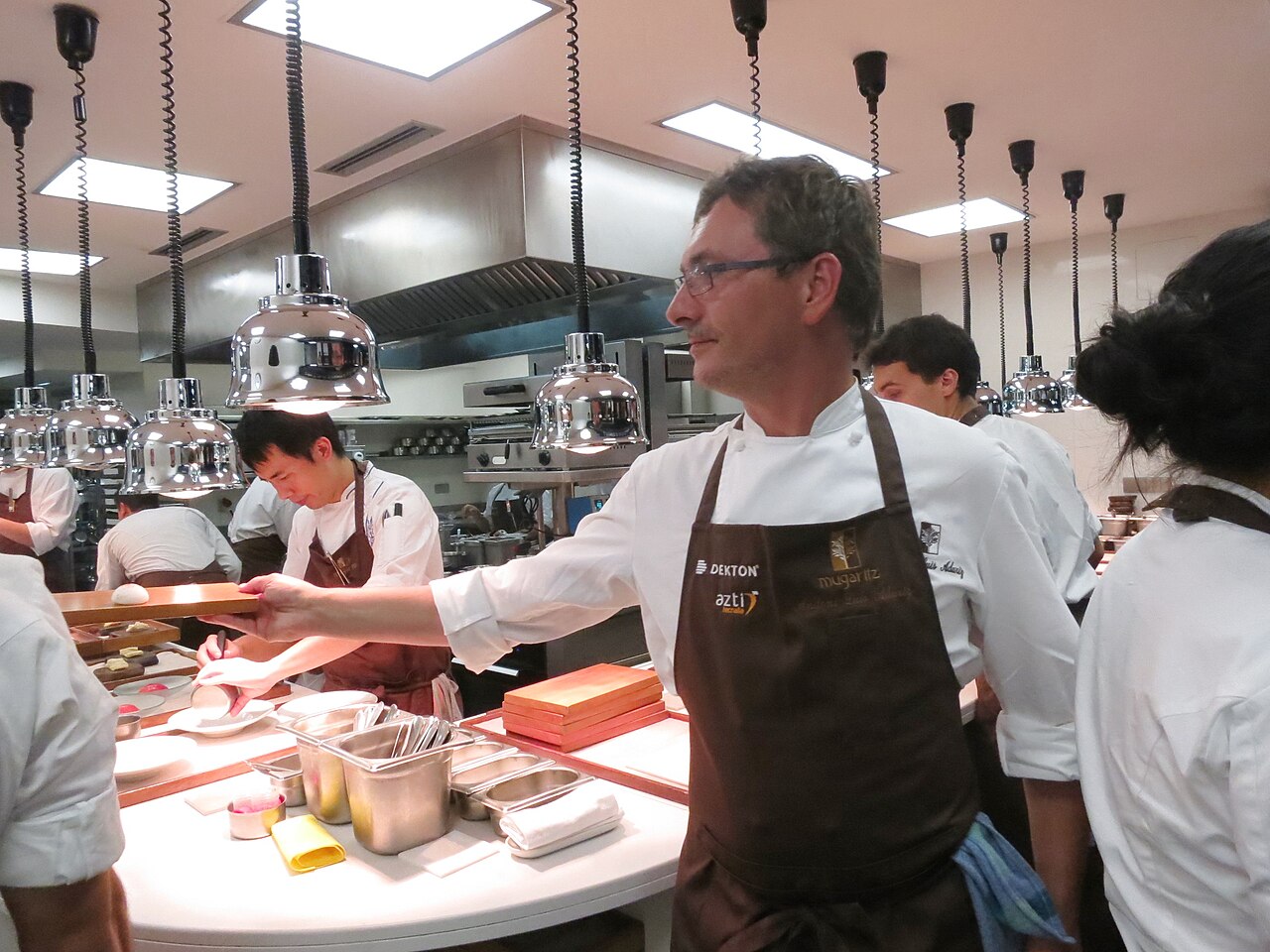
Andoni Luis Aduriz is the Basque chef behind Mugaritz in Errenteria, near San Sebastián in northern Spain. Born in San Sebastián in 1971, Aduriz trained at Arzak, at El Bulli under Ferran Adrià, and at Martín Berasategui’s restaurant before opening Mugaritz in March 1998 at the age of 27. The restaurant has held two Michelin stars since 2005 and spent 14 consecutive years in the top ten of The World’s 50 Best Restaurants, a historical run rather than its current ranking.
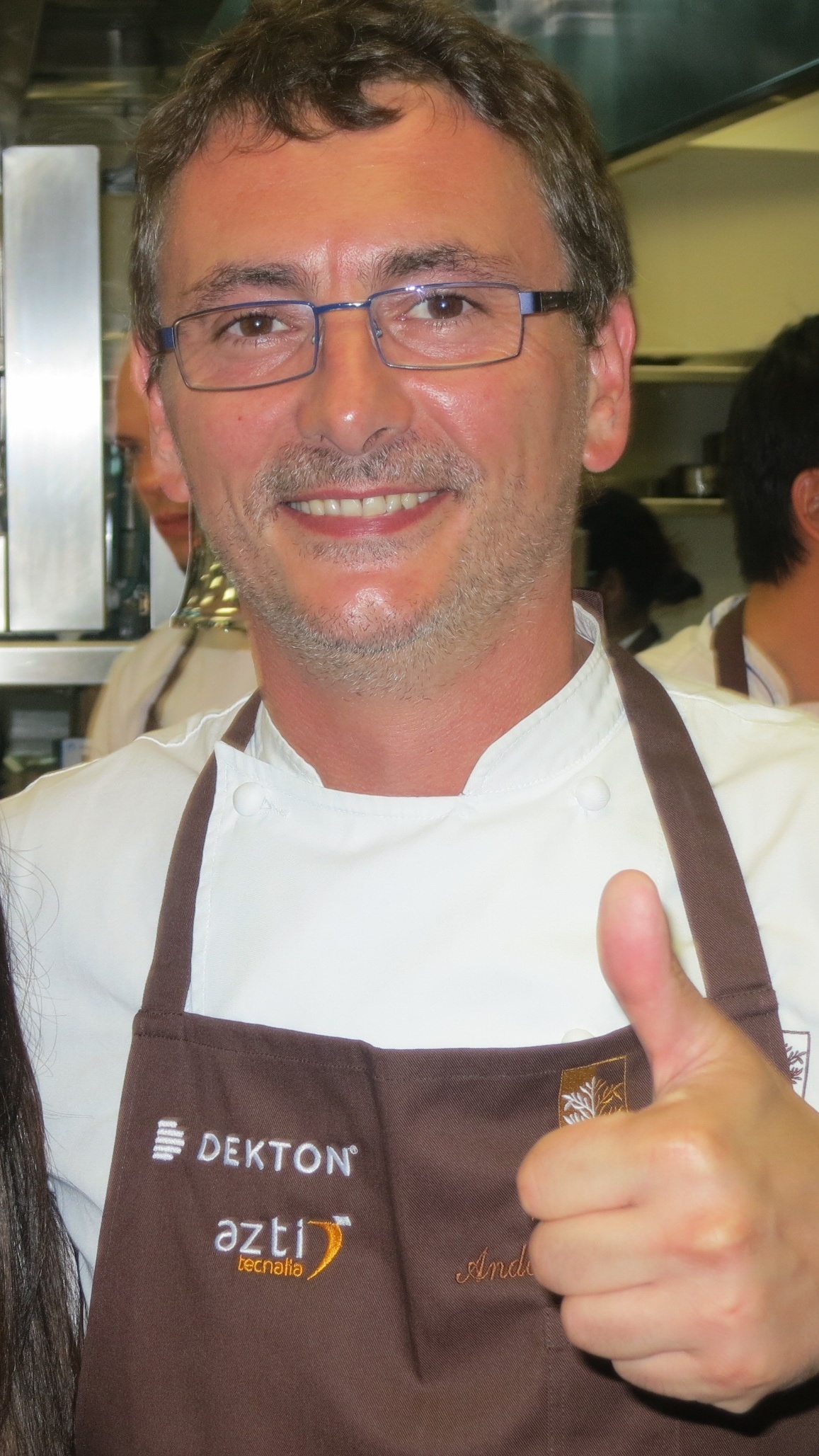
Mugaritz is often described as a laboratory rather than a restaurant. Its creative cycle divides the year into six months of research and six months of service, allowing the team to develop a new proposal each season. Aduriz received the Icon Award at The World’s 50 Best Restaurants 2023 and the Diamond Award for Excellence from the Spanish Luxury Association in 2025.
TL;DR
- Basque chef born 1971 in San Sebastián, Gipuzkoa, Spain
- Chef-owner of Mugaritz in Errenteria, near San Sebastián (opened March 1998)
- Two Michelin stars since 2005, retained continuously
- Trained at Arzak, Martín Berasategui and Ferran Adrià’s El Bulli
- Icon Award at The World’s 50 Best Restaurants 2023; historical 14-year run in the global top ten
Andoni Luis Aduriz key facts
| Born | 1971, San Sebastián, Gipuzkoa, Basque Country, Spain |
| Nationality | Spanish (Basque) |
| Main restaurant | Mugaritz, Aldura Aldea 20, Errenteria, Gipuzkoa (opened March 1998) |
| Michelin stars | Two at Mugaritz since 2005 (first star 2000) |
| Style | Avant-garde Basque; techno-emotional; R&D-driven tasting menu |
| Notable awards | Icon Award World’s 50 Best 2023; Best Chef Science Award 2022; Diamond Award for Excellence 2025 |
| Other ventures | Culinary consultant at LeDomaine Abadía Retuerta; board of Basque Culinary Center; multiple books |
Early life and training of Andoni Luis Aduriz
Aduriz grew up in San Sebastián, a city already recognised as one of the densest Michelin-starred cities in the world per capita. He did not come from a cooking family and initially struggled with formal schooling. He enrolled at the Donostia School of Cuisine in San Sebastián and found that he could express himself through flavours and textures more easily than through academic writing.
His formative stages were in the Basque fine-dining establishment. He worked under Juan Mari Arzak at three-Michelin-star Arzak, under Pedro Subijana at Akelarre, and under Ramón Roteta. In 1993 he moved to Catalonia to join the team at El Bulli under Ferran Adrià, where he spent a formative period during the restaurant’s peak creative years. He returned to the Basque Country to work under Martín Berasategui at Berasategui’s eponymous three-Michelin-star restaurant, where he functioned as a senior member of the creative kitchen. By the late 1990s he had decided to open his own restaurant.
Mugaritz opened in March 1998 in a rural location outside Errenteria, roughly 8 kilometres from the centre of San Sebastián. The name means “oak border” in Euskara, referring to the ancient oak tree that sits on the edge of the property. The first years were extremely demanding: Aduriz has said he worked 12-hour days, seven days a week, and frequently slept in a small annex next to the restaurant because it made no sense to go home when service ended at 2 a.m. and the next shift began at 8 a.m.
Andoni Luis Aduriz career timeline
- 1971: Born in San Sebastián, Basque Country, Spain
- Late 1980s: Enrols at Donostia School of Cuisine in San Sebastián
- Early 1990s: Stages with Juan Mari Arzak, Pedro Subijana and Ramón Roteta
- 1993: Joins Ferran Adrià at El Bulli, Catalonia
- Mid-1990s: Senior position at Martín Berasategui’s restaurant in Lasarte
- March 1998: Opens Mugaritz in Errenteria
- 2000: First Michelin star at Mugaritz
- 2005: Second Michelin star at Mugaritz
- February 2010: A fire damages Mugaritz heavily; reopens later that year
- 2006: Mugaritz begins a 14-year run in The World’s 50 Best Restaurants top ten
- 2011-2012: Mugaritz peaks at No. 3 on The World’s 50 Best Restaurants, behind Noma and El Celler de Can Roca
- 2012: Publishes Mugaritz: A Natural Science of Cooking with Phaidon Press
- 2014: Consulting role at LeDomaine Abadía Retuerta in Valladolid, which earns a Michelin star that year
- 2021: Named Goodwill Ambassador for Japanese Cuisine by the Japanese Ministry of Agriculture, Forestry and Fisheries
- 2022: Best Chef Science Award at The Best Chef Awards
- 2023: 25th anniversary of Mugaritz; Icon Award at The World’s 50 Best Restaurants, presented by Massimo Bottura in Valencia
- 2024: Named Esquire Man of the Year in the gastronomy category; Creativity Award at the Fuera de Serie Gourmet Awards
- 2025: Diamond Award for Excellence from the Spanish Luxury Association
- June 2026: Receives the Gold Medal of the Círculo de Bellas Artes in Madrid, the first chef to do so
Andoni Luis Aduriz signature style: the restaurant as laboratory
The defining structural decision at Mugaritz is that the restaurant dedicates about six months each year to research rather than service so the creative team can develop a new tasting menu. During those months the kitchen functions as a formal R&D laboratory. An invisible quartet of researchers (Sasha Correa, Julián Otero, Ramón Perisé and Javier Vergara, as of 2023) develops and tests dishes that will appear in the following season. Few restaurants at this level devote that much of the calendar to creation rather than service.
The cooking itself is often described as techno-emotional. The goal is not simply deliciousness; it is surprise, disorientation and a particular philosophical register that Aduriz has compared to the Kantian sublime. Dishes challenge expectations: edible stones that turn out to be potato, dishes served without cutlery that guests must eat with their hands, a course that is just a kiss between the guest and a mould of a team member’s face, dishes named with provocations rather than descriptions. Mugaritz has served courses that explicitly ask guests to consider discomfort or transgression as part of the meal.
Aduriz has been explicit that Mugaritz does not try to produce “good” food in the conventional sense. He prefers the word “interesting”. Mugaritz aims for a reaction that guests describe as “wow, that was exciting” rather than “that was delicious.” The approach sits deliberately at the boundary of fine dining, performance art, food science and philosophy. Ferran Adrià has said Mugaritz is one of the few restaurants where he has been served things he cannot work out how to produce.
Notable dishes and concepts at Mugaritz
Several Mugaritz courses have become reference points in avant-garde cuisine. The Edible Stones (served in the 2000s) were small potatoes cooked in a clay coating that looked exactly like river stones, setting the restaurant’s tone of perceptual play. The vegetable-based broths and fermentations developed across multiple seasons have demonstrated what deep plant-driven cooking can become. The provocation dishes (a kiss without silverware, a course served on a mould of a team member’s face, courses that arrive with a provocative title on the menu rather than an ingredient list) are the clearest expression of Aduriz’s argument that a restaurant can function as a theatre piece. And the restaurant’s long foraging and fermentation work (bacterial cultures, mosses, wild plants from the Basque hills) has shaped an entire generation of younger chefs.
Andoni Luis Aduriz awards and recognition
- 2000: First Michelin star at Mugaritz
- 2003: Euskadi Award for best restaurateur (Basque Academy of Gastronomy)
- 2005: Second Michelin star at Mugaritz
- 2006, 2012: Chef’s Choice Award at The World’s 50 Best Restaurants
- 2006-2019: Mugaritz in The World’s 50 Best Restaurants top ten (peak at No. 3 in 2011 and 2012); ranked No. 81 in 2024 and No. 87 in 2025 on the extended list
- 2018: Royal Academy of Gastronomy Healthy Gastronomy distinction
- 2021: Goodwill Ambassador for Japanese Cuisine (Japanese Ministry of Agriculture)
- 2022: Best Chef Science Award at The Best Chef Awards
- 2023: Icon Award at The World’s 50 Best Restaurants
- 2024: Esquire Man of the Year (gastronomy)
- 2025: Diamond Award for Excellence from the Spanish Luxury Association
Andoni Luis Aduriz impact on contemporary gastronomy
Aduriz’s most concrete contribution is the model of the restaurant as a creative laboratory rather than as a service operation with an occasional new dish. The Mugaritz annual cycle (six months of service, six months of R&D) has been adopted in modified form by several fine-dining kitchens since. René Redzepi‘s Noma, Rasmus Munk‘s Alchemist and Gaggan Anand‘s various projects all use comparable R&D structures that owe something to the Mugaritz template.
His second contribution is interdisciplinary. Aduriz sits on the board of the Basque Culinary Center and the Tufts Nutrition Council, works with marine research centre AZTI and the Imagineering Institute, and has collaborated with the theatre collective La Fura dels Baus. The argument is that fine dining can be a legitimate site of research across fields (nutrition, cognitive science, marine biology, performance art) rather than an isolated craft. The Mugaritz BSO and OFF-ROAD documentaries developed from this position.
Within the Basque generation he sits alongside Juan Mari Arzak (his mentor), Martín Berasategui and Pedro Subijana as one of the defining figures of modern Basque cuisine. His El Bulli training also places him in the post-elBulli generation alongside Albert Adrià, Grant Achatz and Gaggan Anand, all of whom developed their own distinct approaches after passing through Roses.
Andoni Luis Aduriz FAQ
How many Michelin stars does Mugaritz have?
Two Michelin stars, continuously since 2005. Mugaritz earned its first Michelin star in 2000 and its second in 2005 and has retained both stars every year since, including in the 2026 Michelin Guide Spain.
Why does Mugaritz close for part of the year?
To allow the creative team to develop a completely new menu for the following season. Mugaritz runs R&D as a formal programme with a dedicated team of researchers who test dishes that eventually appear on the tasting menu. The annual closure is a structural feature of the restaurant, not a seasonal one.
Where did Andoni Luis Aduriz train?
At the Donostia School of Cuisine in San Sebastián, then under Juan Mari Arzak at Arzak, Pedro Subijana at Akelarre, Ramón Roteta, Ferran Adrià at El Bulli (from 1993) and Martín Berasategui at his eponymous three-star restaurant in Lasarte.
What does Mugaritz mean?
“Oak border” in Euskara, the Basque language. The name refers to the ancient oak tree on the edge of the restaurant’s rural property outside Errenteria, which marks the boundary of the site.
Is Mugaritz a fine-dining restaurant?
Technically yes, but Aduriz has consistently framed Mugaritz as “something more” than a restaurant. The cooking deliberately challenges the idea that fine dining should aim primarily for deliciousness, favouring surprise, disorientation and conceptual provocation as the primary goals.
What is next for Andoni Luis Aduriz
The 2026 Mugaritz season ran from 1 May to 25 October, following six months of development and exploring familiar assumptions about taste, luxury and comfort. In April 2026, Aduriz also announced No sé. Y otras certezas, a collection of reflections on eating as a cultural and political act. Check the restaurant’s official website for future season announcements and reservations.
